
If you own an investment property in Edison, Metuchen, East Brunswick, or anywhere else in Central Jersey, selling it outright can trigger a large capital gains tax bill. A 1031 exchange lets you sell an investment property and roll the proceeds into another one, deferring that tax rather than paying it now. This guide walks through how it works, the two deadlines that make or break an exchange, and what’s specific to doing one in New Jersey.
What Is a 1031 Exchange?
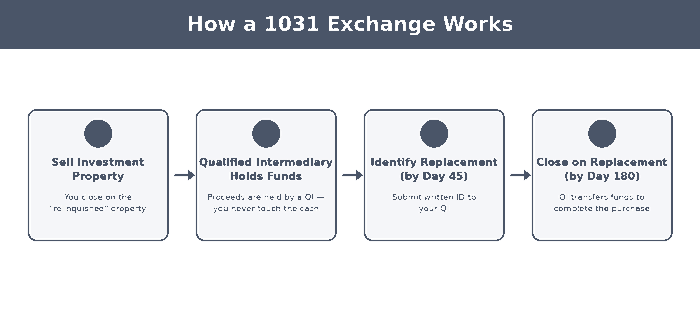
Named for Section 1031 of the federal tax code, a 1031 exchange allows investors to defer capital gains tax and depreciation recapture when they sell an investment property, as long as they reinvest the proceeds into a “like-kind” investment property. The tax isn’t eliminated — it’s deferred, rolling forward into the cost basis of the replacement property — but deferring it means more of your capital keeps working for you instead of going to the IRS this year.
The Two Deadlines That Govern Every Exchange
Both deadlines start counting from your closing date on the property you sell (the “relinquished” property), and both run on calendar days — weekends and holidays don’t extend them.
- Day 45 — Identification. You must formally identify your replacement property (or properties) in writing to your qualified intermediary.
- Day 180 — Completion. You must close on the replacement property and complete the exchange.

Because these clocks start at closing, the time to line up a qualified intermediary is before you even list your relinquished property — not after you’ve already accepted an offer.
Core Rules to Know
- Like-kind, investment use. Both properties must be held for investment or business use — your primary residence doesn’t qualify.
- Same taxpayer. The entity that sells the relinquished property must be the same one that buys the replacement.
- Equal or greater value. To defer the full tax, the replacement property should be equal or greater in value, with all equity reinvested.
- A qualified intermediary is required. Sale proceeds must be held by a qualified intermediary between closings — if the cash touches your hands, the exchange fails.
What’s Different About Doing a 1031 Exchange in New Jersey
New Jersey follows the federal Section 1031 rules for real property, so a properly structured exchange can defer both federal and New Jersey state tax on the gain. A few state-specific points are worth knowing before you go under contract:
- A qualifying exchange generally avoids triggering New Jersey’s non-resident seller withholding, since the gain is being deferred rather than realized — your accountant and closing attorney should confirm this applies to your specific transaction.
- Your qualified intermediary agreement needs to be in place and signed before the relinquished property closes. Setting this up after closing forfeits the exchange.
This is general information, not tax or legal advice. Every transaction has its own details, so talk with a New Jersey-licensed CPA and real estate attorney before structuring an exchange.
Frequently Asked Questions
Does New Jersey’s non-resident withholding apply to a 1031 exchange?
New Jersey generally requires non-resident sellers to prepay estimated state tax at closing. This withholding is typically not triggered when a sale qualifies as a valid 1031 exchange, since the gain is deferred rather than realized. Confirm with a CPA familiar with NJ real estate transactions.
When do I need to line up a qualified intermediary for a Central Jersey property?
Before your relinquished property closes — ideally weeks before you even list it in Edison, Metuchen, or elsewhere in Middlesex County. A QI agreement signed after closing invalidates the exchange.
Can I 1031 exchange an investment property in East Brunswick for one in South Brunswick?
Yes — “like-kind” for real estate is broad. Any investment or business-use real property can generally exchange for any other, regardless of which Central Jersey town it’s in, as long as the other 1031 rules are met.
Thinking About an Exchange?
Timing is everything with a 1031 exchange — the clock starts the moment you close. If you own investment property in Central Jersey and are considering a sale, let’s talk before you list, so we can line up your replacement property search and a trusted qualified intermediary together.
Let’s talk about your exchange →
Jasmine Tsui (徐佳美)
Weichert Realtors, North Edison — NJ Real Estate License #2075070
201-920-5825 | NextMoveNJ.com
Equal Housing Opportunity. This article is for general educational purposes only and is not tax, legal, or investment advice. Consult a qualified CPA and real estate attorney to evaluate your specific situation before pursuing a 1031 exchange.